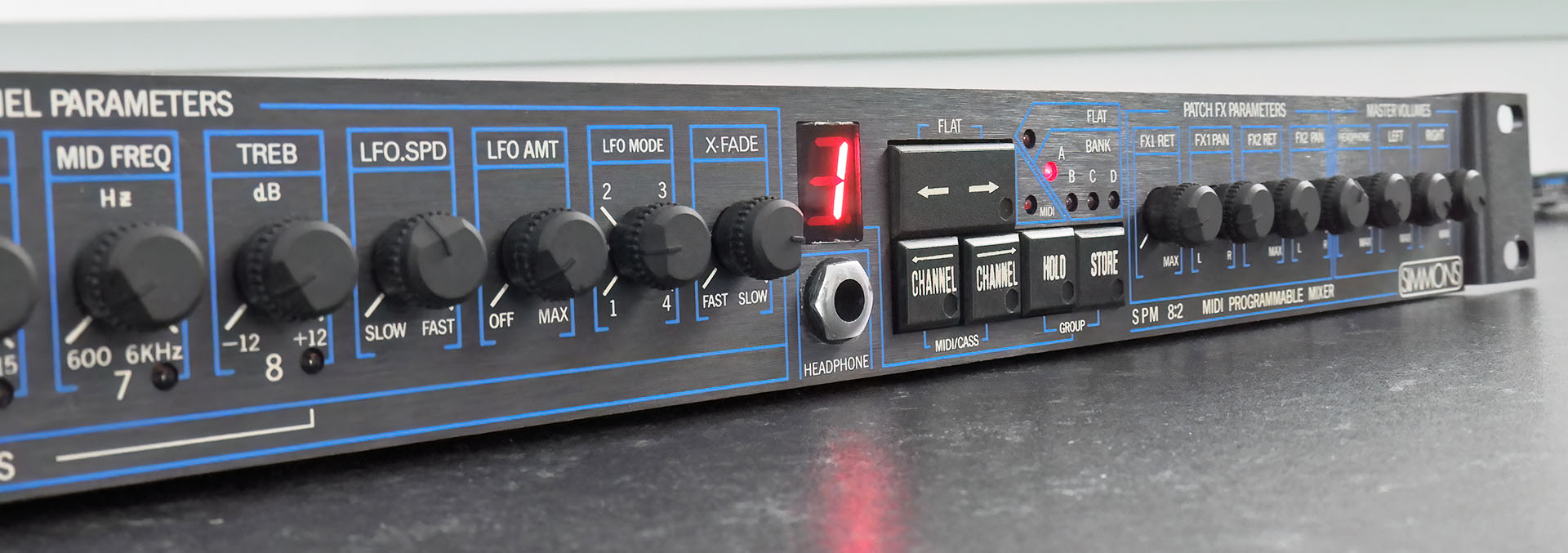
A few weeks ago, I decided to test an old theory of mine; a simple cable change for a Simmons SPM8:2 noise reduction mod.
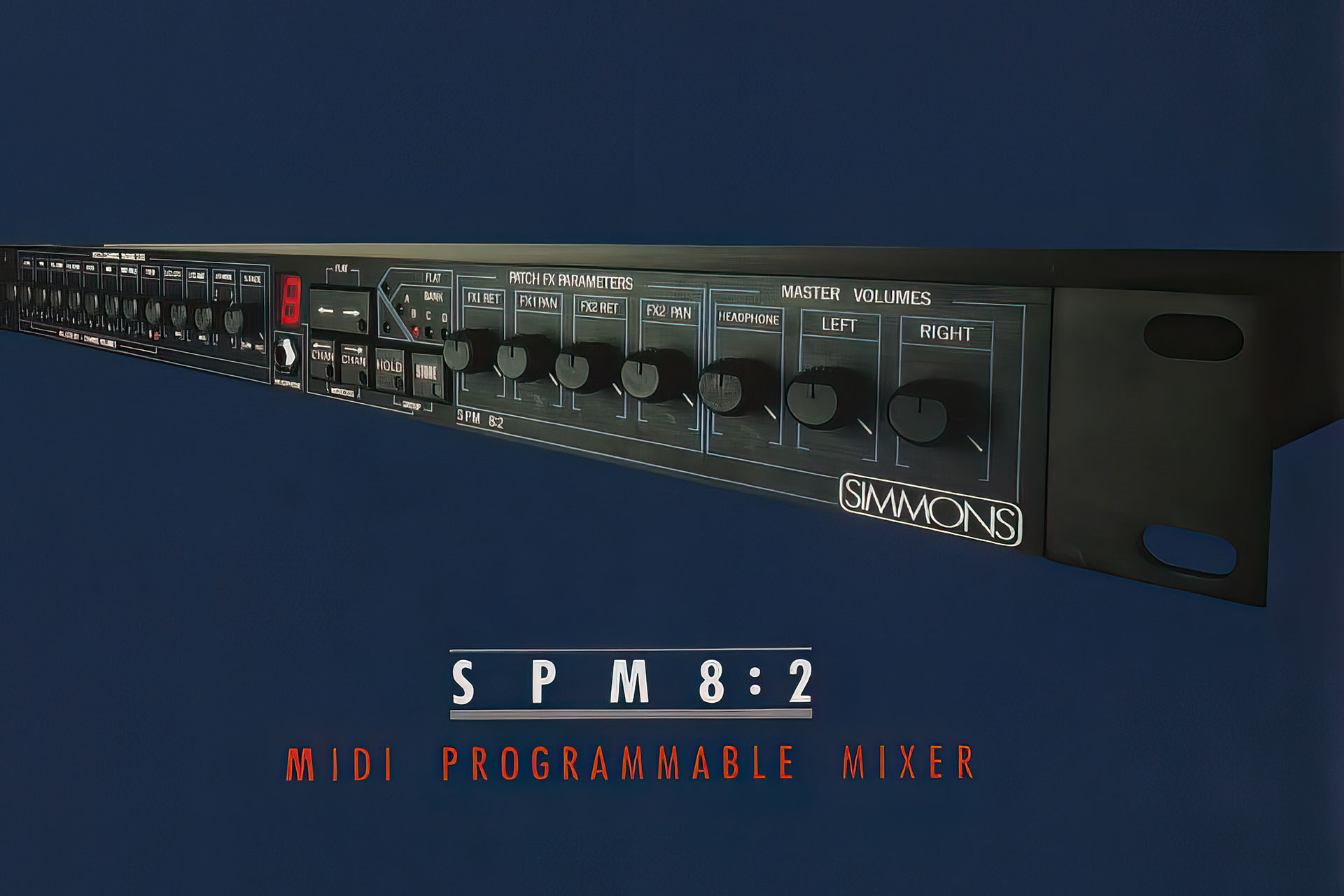
Back in 1987, one of the revolutionary products that Simmons released was the SPM8:2 digitally controlled analogue mixer.
The world simply hadn't seen anything like this before. Suddenly, keyboard players, e-drummers and even studio engineers, could knock up a mix of eight signals, with effects, store that mix in a patch and recall several patches during a single performance or recording session.
Crammed into 1U, things were tight and indeed apart from heat, the SPM8:2, was criticised for its poor noise levels. There was and still is, talk about replacing the TL084s with more modern devices like the OP471. Geesh, people even said that TL072s would deliver an improvement. The use of transconductance amplifiers (OTAs) to control analogue signals helped a lot. Being current-based, there was very little cross-talk from control voltages to audio, inside the control ICs.
The truth however, is that the noise results from the close proximity of the digital electronics to the analogue electronics. The fact that the characteristic of the noise is not your classic and constant shhhhhhh but a type of chatter, confirms that. Shorting all inputs and muting all channels doesn't alter things too much so again, it seems that noise is being generated internally.
Okay, so let's have look...
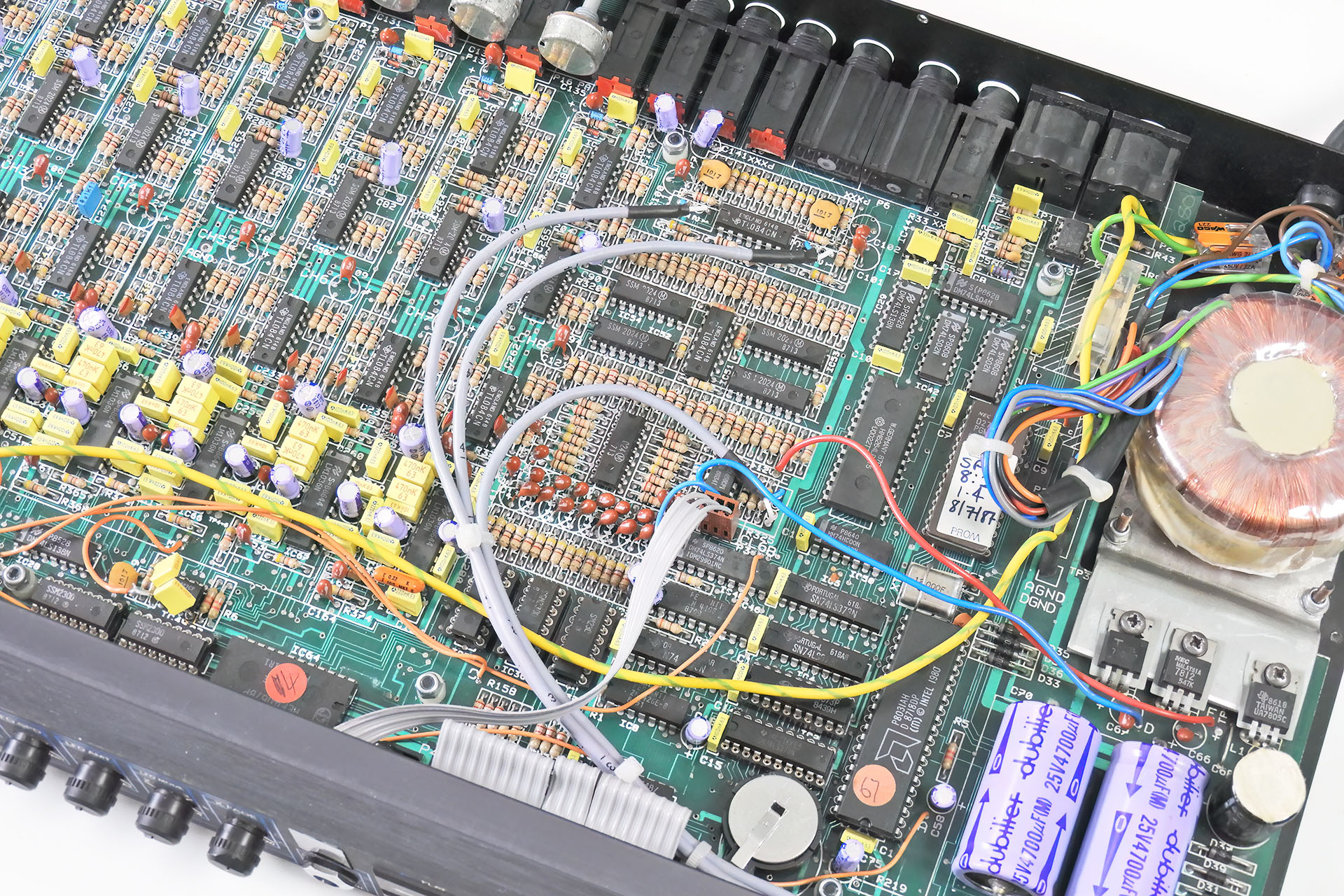
Anyone familiar with the insides of the SPM8:2 will notice three black cables coming from the front right to the middle right of the PCB. These cables carry analogue audio to and from, the volume and headphone potentiometers on the front panel and go straight over all the digital stuff. They also pass very close to the power supply.
Hmm... not good.
By the late eighties, Simmons was using a new type of cable for drum trigger assemblies. The new cable utilised a conductive polymer shield which provided a cost-effective and flexible solution. Well, they also used this cable for those signal-carrying lines in the SPM8:2, which mightn't not have been the best idea.
A few weeks ago, I pulled an old SPM8:2 out of storage. The thing hadn't been used for years so I thought I'd give it the once-over and see what I could do about that noise.
First things first. The Ni-Cd battery had just started leaking so it was quite fortuitous that I decided to do this when I did. I modified the circuit to take a lithium CR2032 and changed a couple of 74LS373 flip-flops that had suffered a little battery acid damage and weren't driving the 7-segment display and LEDs properly.
NOTE: I said "I MODIFIED the circuit". did NOT say "I just dropped in another type of battery". Go figure!
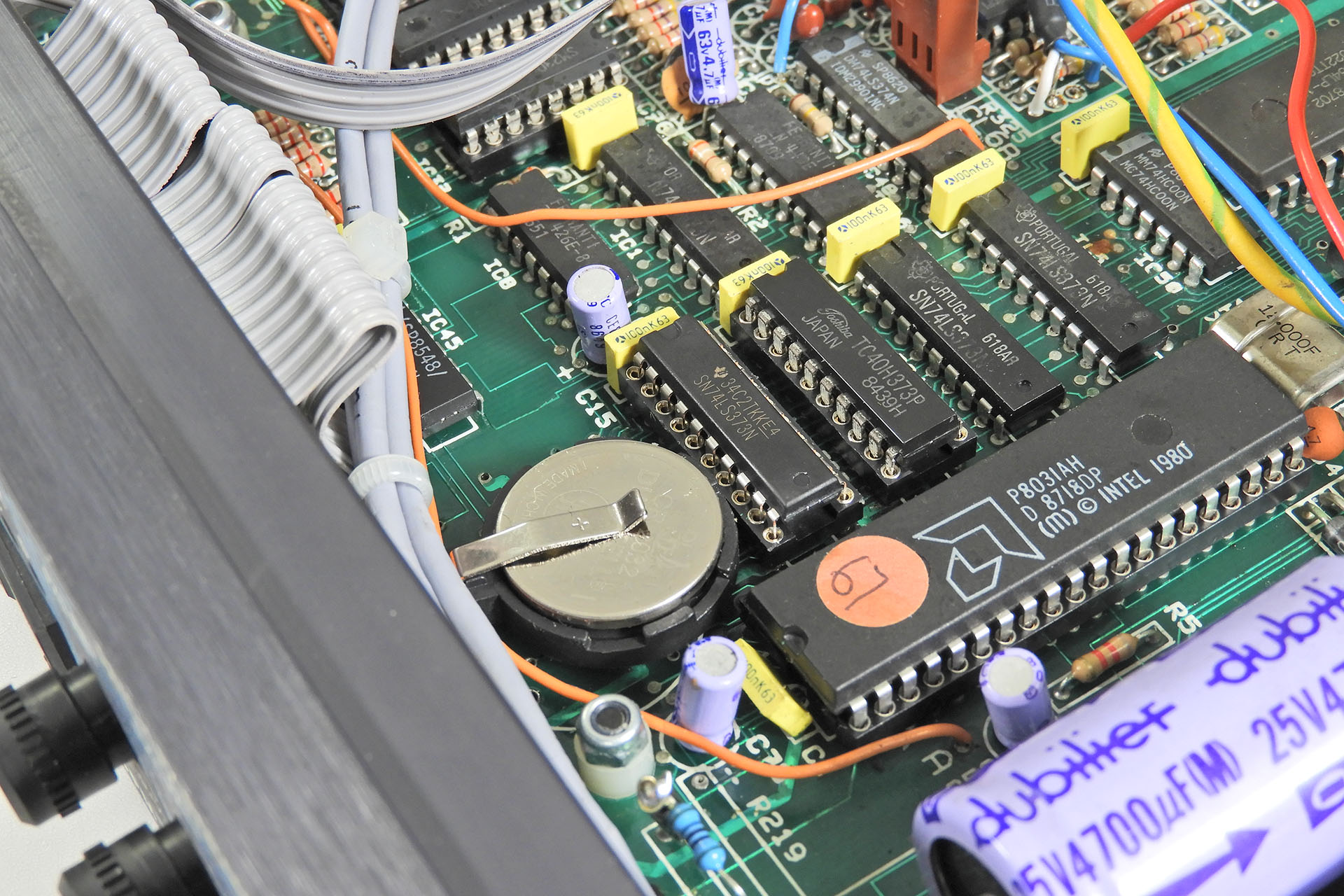
Unfortunately but kind of as predicted, my battery leakage problems didn't stop at those two 74LS373s. Once powered up and with a fully working display and LEDs, flicking through channels and parameters, I couldn't find anything wrong but... I did notice some 'fur' around IC45 which is a 74LS175 (another flip-flop) and at least one broken track. IC46 multiplexes signals off the front panel pots. IC45 then feeds them onto a single buss.
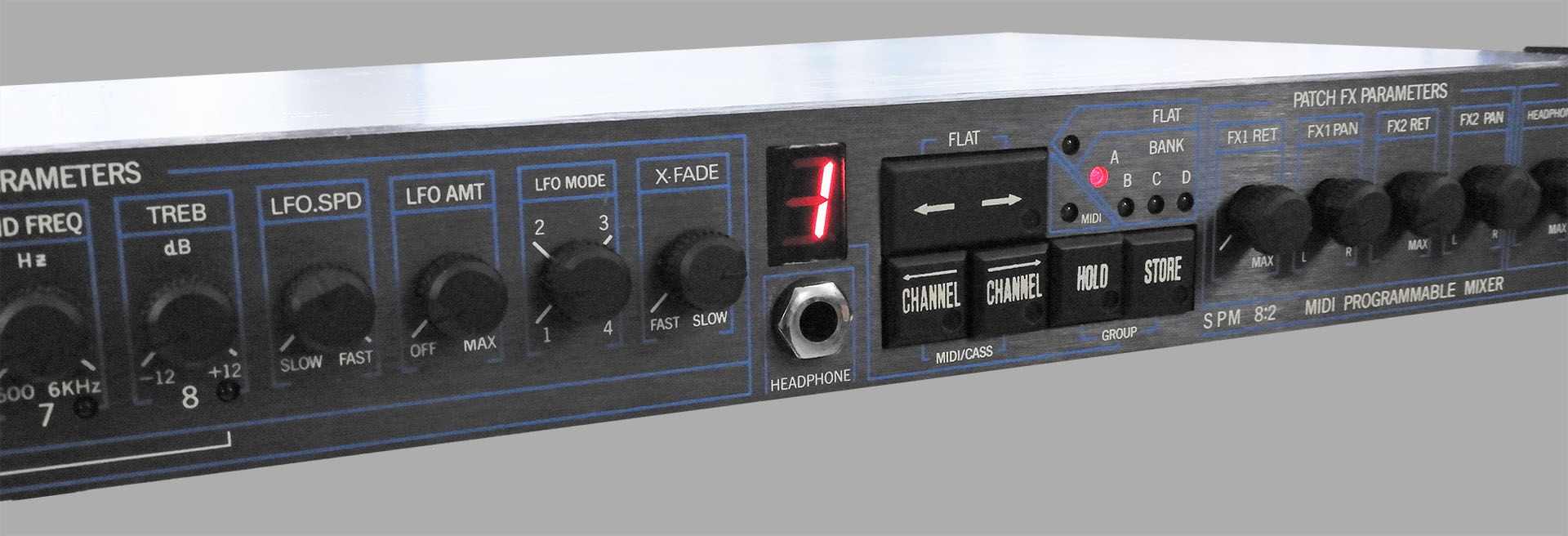
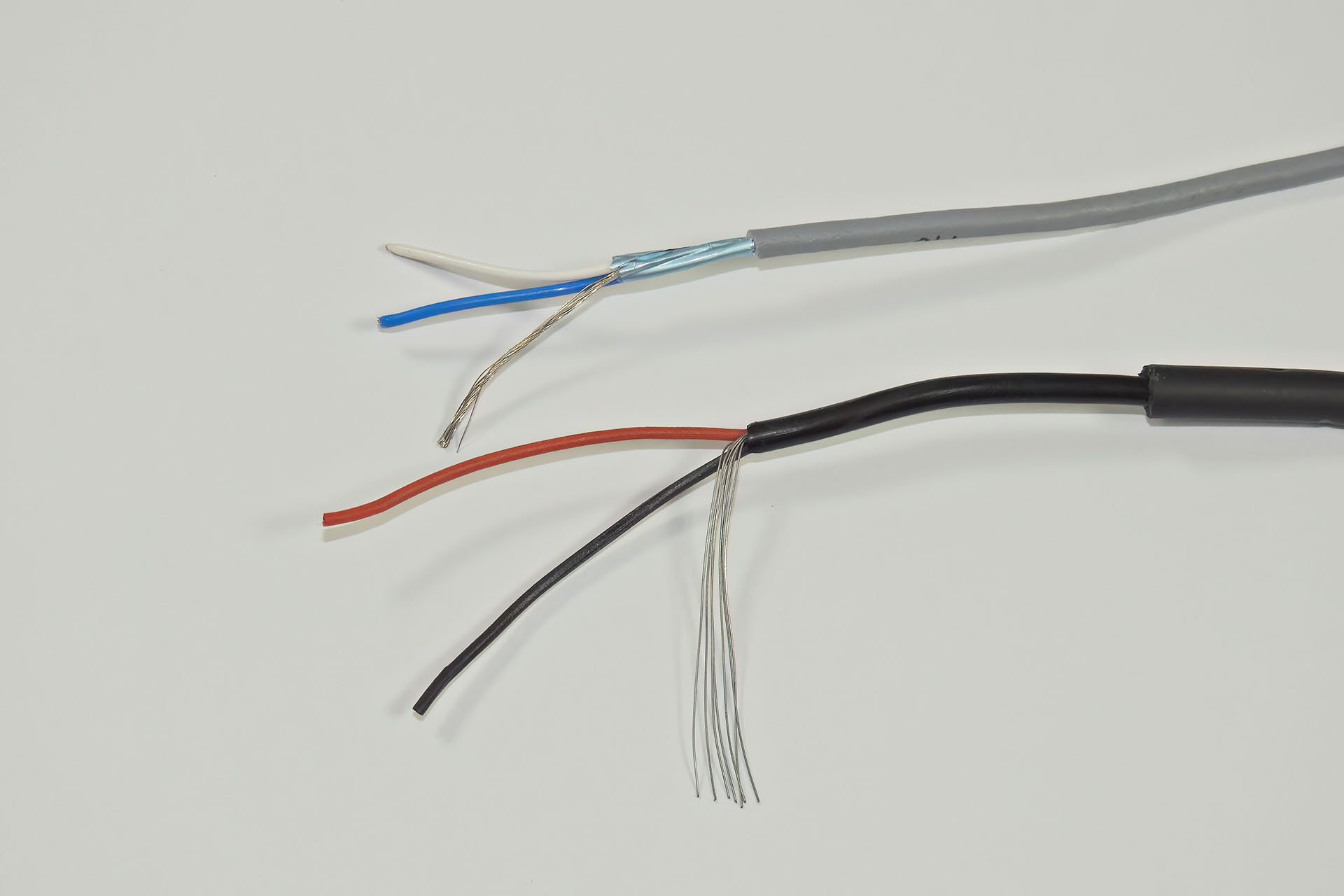
Okay, so in short, my Simmons SPM8:2 noise reduction mod entails replacing the original conductive polymer flying leads with fully shielded multi-core lines. The cables have a 100% metal foil shielding and in my humble opinion, would provide much better noise immunity than the stuff that Simmons used back in 1987.
Well, the results were quite startling as the replacement cables did indeed reduce the effect of all that digital chatter. My Simmons SPM8:2 noise reduction mod might inspire me to look into this a little further.
The power supply in the Simmons SPM8:2 delivers +/-12V for the analogue. While quite adequate for connection of keyboards and of course electronic drums, the mixer can only operate at -10dBm. One option I'm looking into, is modifying things so that the SPM8:2 can operate at +/-15V. Right now, I'm not at all sure if that's possible but if it is, then doing so, may increase the signal-to-noise ratio, as well as making the outputs compatible with more modern destination devices running at +4dBm.
I think I'm also going to look at the earth on this box as apart from noise, the level of 100Hz (don't forget I'm in the UK so our mains is 50Hz), is more than I think it should be.
The nature of the noise, makes setting up a single-ended noise suppression solution across the outputs, somewhat challenging. With a little patience and careful configuration of the expander and gate sections however, it can be done. When material is playing through the system at normal levels, the noise is inaudible. It's just when things go quite, that you kind of think you can hear all those chips talking to each other!
I didn't expect my Simmons SPM8:2 noise reduction mod to work miracles but I have to admit to be being somewhat impressed with my modest efforts. I think with a little more work, this old Simmons MIDI programable mixer, might actually get some use. 🙂
The eighties was an exciting time for musicians and producers but the explosion of gear ironically left a few holes. In 1987, Simmons intended to fill one of those holes with the SPM 8:2 which ended up being used probably more by keyboard players than e-drummers. I myself had three or four of them, specifically as sub-mixers.
At 599 GBP it wasn't cheap but you have to remember of course, that it wasn't just an 8-channel mixer, it was programmable and that was a very welcome feature at the time. Why? Well ironically, one reason was that you could mute the sound sources that you weren't using in a particular performance and thereby... keep the noise level down! ?
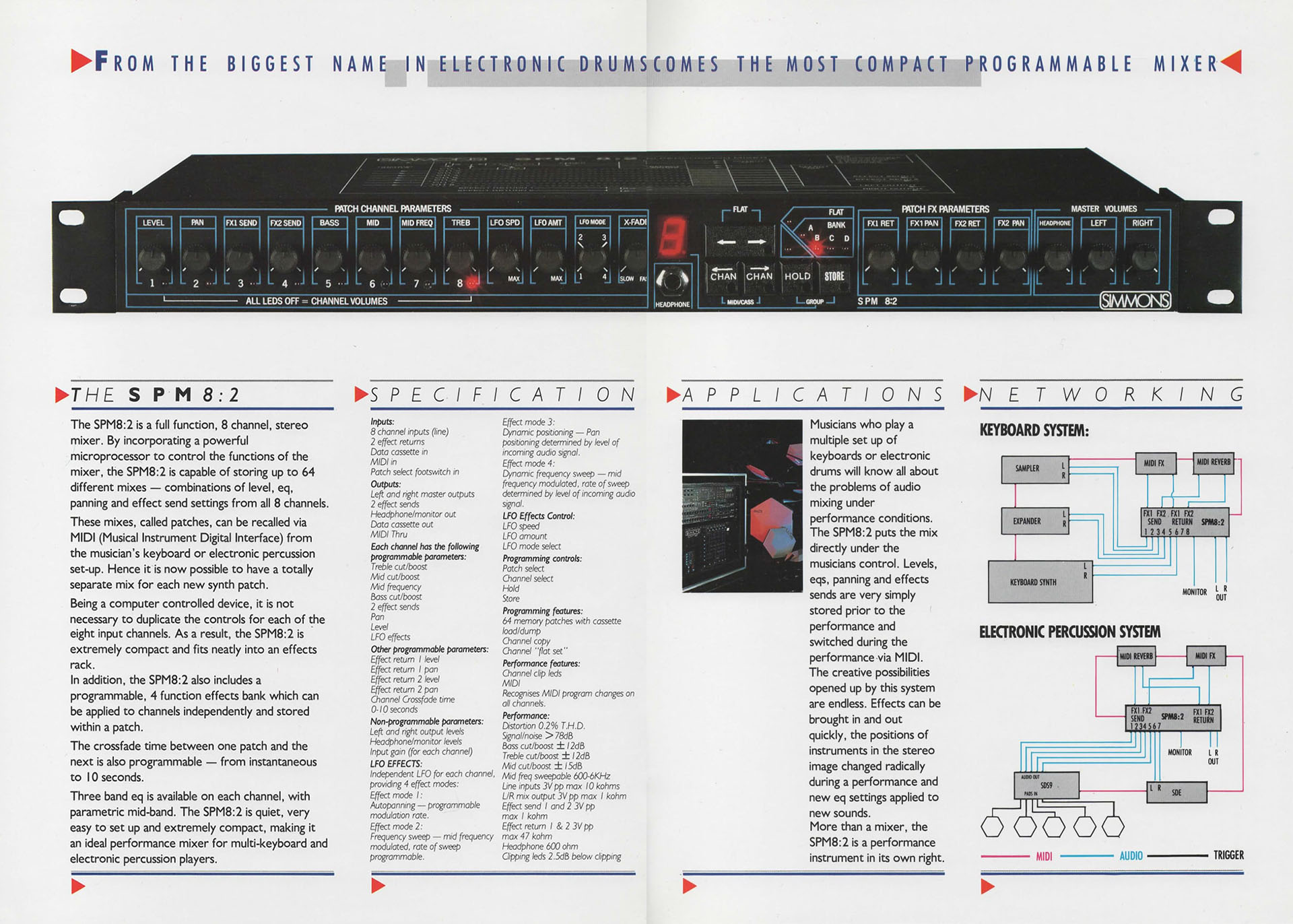
Ushering in a new era which would soon become dominated by machines with controls that did several functions and even requiring users to press a combination of buttons to do perhaps, deeper tasks, the SPM8:2 was amongst the first to lose the ergonomics of the analogue box. Having said that, we seemed to be happy with the sacrifice of old ergonomics and musicians, engineers and producers quickly accepted the fact that now, they would have to 'learn' stuff!